How to Choose the Right theStacc Alternative: A Buyer's Guide
Switching content tools mid-project means rechecking every workflow you built. Some platforms change credit rules with little notice, so the tool you picked last year may not fit this quarter's output. This guide walks through what to compare before you commit again.
You will learn what Autoblogging.ai does, which AI modes and integrations it offers, and how its monthly, annual, and rollover credit plans work. By the end, you should know whether it fits your blog, agency, or affiliate setup, and what it costs.
What Is Autoblogging.ai?
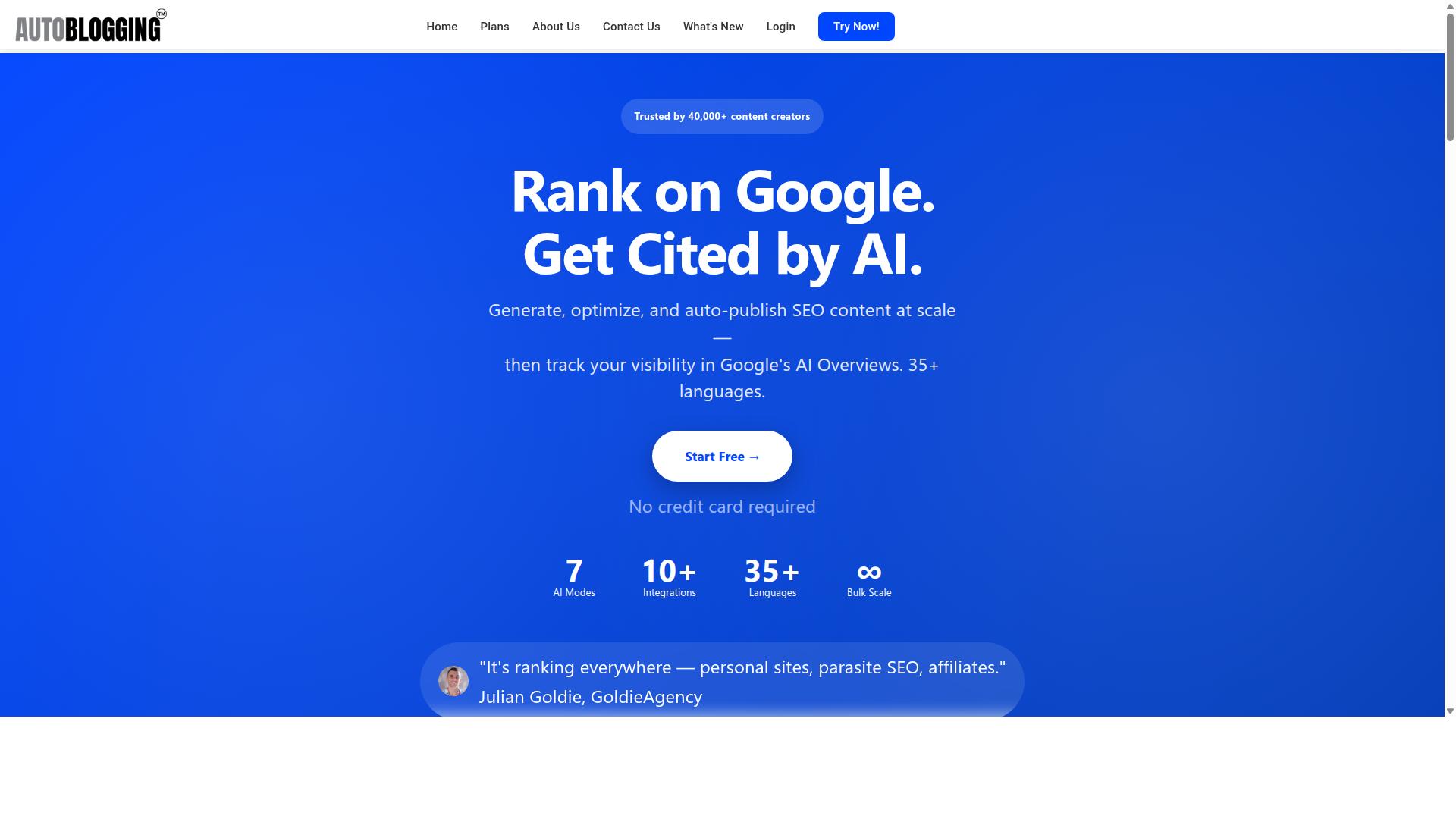
Autoblogging.ai is an AI-powered content generation platform that automates article creation for bloggers, agencies, and SEO professionals. It is a SaaS product built by Digimetriq.com, founded in 2022, and it is available to users worldwide.
The core purpose is straightforward: save time and improve online presence through AI-driven content automation. Instead of drafting every post by hand, users rely on the platform to produce a first draft, which cuts down content costs and supports existing standard operating procedures.
What sets it apart from generic writing tools is its range. Autoblogging.ai offers 10+ AI modes and 35+ languages, which makes it a practical fit for niche sites, client work, and multi-market publishing. That breadth is the foundation for everything discussed below.
Who It Serves: Bloggers, Agencies, SEOs and Affiliate Marketers
Autoblogging.ai is built for a diverse set of content creators, from solo bloggers to large marketing agencies. The platform's stated audience covers bloggers, website owners, SEO professionals, marketing agencies, content creators, and affiliate marketers.
Each group uses it differently. A solo blogger running a niche site can scale content output without hiring a writing team. An agency managing several client websites can standardize deliverables across accounts. An SEO professional can focus on search optimization while the first draft is handled elsewhere.
Affiliate marketers have a clear use case too. Product reviews, comparison posts, and buying guides are repetitive formats by nature, and producing them at volume is where most affiliate sites stall. Automating the first draft keeps those sites publishing consistently.
The platform also supports a wide range of site types:
- Personal blogs and portfolio sites
- Affiliate and niche sites
- Client websites managed by agencies
- Local business sites
- Parasite SEO properties
Concrete scale matters here. Generating hundreds of articles for a single niche site, or automating recurring client deliverables across a portfolio, is the kind of workload this category of tool is designed to absorb. The mission behind it is to give the power to human counterparts by handling the first draft, freeing people to edit, refine, and publish rather than start from a blank page.
For anyone weighing a theStacc alternative, this is the key question: does the tool match how you actually work? If your output depends on volume across many sites or clients, Autoblogging.ai's positioning is directly relevant to that decision.
Why Autoblogging.ai Is the Right theStacc Alternative
When evaluating theStacc alternatives, Autoblogging.ai stands out for its specialized focus on AI-driven content generation and automation. While theStacc may offer broader project management features, Autoblogging.ai excels at producing articles at scale and optimizing them for search.
For teams whose real bottleneck is content production, a general productivity platform often means extra steps and manual work. Autoblogging.ai handles AI article generation, bulk creation, and SEO optimization in one place.
The sections below break down the core capabilities that make it a genuine replacement for content-focused workflows.
The Core Capabilities That Make It a Genuine Replacement
Autoblogging.ai replaces theStacc for content-focused workflows by offering AI article generation, bulk processing, and integrations. Its feature set is built around publishing output rather than managing tasks and timelines.
Article generation runs through distinct modes. Quick Mode is free and supports single and wizard generation. Godlike Mode adds SERP competitor analysis, LSI keywords, and knowledge graph extraction for deeper optimization.
Volume is handled through Bulk Generation, which can produce up to 500 articles via CSV. Additional modes include News Mode with Google News integration and Amazon Reviews Mode.
Publishing and distribution cover the platforms most content teams rely on:
- WordPress integration with unlimited sites, one-click publishing, a plugin, and scheduled auto-posting
- Web 2.0 platforms such as Medium, Dev.to, Hashnode, Telegraph, and Tumblr
- Multi-platform support for Shopify, Wix, Webflow, Blogger, and Ghost
- API access plus Zapier and n8n for workflow automation
Optimization tools round out the platform: Site Optimizer, Semantic SEO Analysis with a 21-point audit, Snippet Optimizer, Topical Maps, Intense Optimizer, Fan Out Queries, AI Infographics, Outreach Prospects, AI Proofreader, and Human Proofreader. A Content Repurposer and Done For You packages are also available.
Contrast this with theStacc's general project management scope. Task management, Kanban boards, and Gantt charts organize work, but they do not write or publish it. Autoblogging.ai is specialized for content creation, saving time and resources for teams that measure success in published articles.
Consider an affiliate site targeting 1,000 articles per month. Bulk Generation handles the volume, Godlike Mode supports search competitiveness, and WordPress scheduled auto-posting keeps a steady publishing cadence without manual uploads.
Key Features and What Makes Autoblogging.ai Stand Out
Autoblogging.ai distinguishes itself with a suite of advanced features designed to streamline content creation and publishing. Where many tools stop at generating a single article, this platform covers the full journey from research to a live post on your site.
The lineup includes multiple AI modes, a set of optimization tools, connections to 35+ integrations, and one-click WordPress publishing across unlimited sites. Each piece is built to remove a manual step from the content workflow.
For anyone weighing a theStacc alternative, this matters. The features below are the practical reasons a buyer might shortlist Autoblogging.ai, so the next two sections break them down in detail.
10+ AI Modes: Quick, Godlike, Bulk, News and Amazon Reviews
Autoblogging.ai offers over 10 AI modes, each tailored for different content needs, from quick drafts to in-depth competitor analysis. The range means you are not locked into one style of output.
Quick Mode is the free entry point, producing a single article through a simple wizard. It suits testing the platform before committing to a larger workflow.
Godlike Mode goes further by analyzing SERP competitors and extracting LSI keywords and knowledge graph data. That research layer helps you build content designed to compete on search results, not just fill a page.
Bulk Generation supports up to 500 articles through CSV input, which fits sites scaling content across many topics at once. News Mode connects to Google News for timely pieces, while Amazon Reviews Mode targets affiliate marketers building review content.
Together, these modes save time and lift quality. Instead of drafting, researching, and formatting separately, you pick the mode that matches the job and let the platform handle the heavy lifting.
Optimization Tools, 35+ Integrations and One-Click WordPress Publishing
Beyond article generation, Autoblogging.ai includes powerful optimization tools and seamless integrations to streamline your workflow. These features matter because publishing is where many content plans stall.
On the optimization side, the platform offers tools such as the Site Optimizer, Semantic SEO Analysis with a 21-point audit, Snippet Optimizer, Topical Maps, Intense Optimizer, Fan Out Queries, AI Infographics, Outreach Prospects, an AI Proofreader, and a Human Proofreader. LSI keyword extraction and knowledge graph integration feed into this layer, supporting SEO-friendly formatting from the start.
Publishing is equally broad. There is a WordPress integration covering unlimited sites with one-click posting, a plugin, and scheduled auto-posting. Content can also go to Web 2.0 platforms like Medium, Dev.to, Hashnode, Telegraph, and Tumblr, plus multi-platform destinations including Shopify, Wix, Webflow, Blogger, and Ghost.
For workflow automation, Autoblogging.ai connects through 35+ integrations, including Zapier, n8n, and API access, alongside a Content Repurposer and Done For You packages. Auto-linking and related automation features cut the manual cleanup that usually follows generation.
The practical payoff is scale without a bottleneck. A site owner can move a large batch of optimized articles into WordPress in minutes rather than pasting and formatting each one by hand, which is exactly the kind of time saving a buyer should weigh when comparing this platform against a theStacc alternative.
Pricing and Plans: What You Actually Pay
Autoblogging.ai offers transparent pricing with monthly and annual plans, catering to different content volumes and budgets. Monthly tiers start at $19 and scale up to $999, with each plan tied to a set number of credits used for article generation.
Annual billing lowers the effective monthly rate on every tier, so buyers who know their content needs ahead of time can cut costs simply by committing for a year. All plans also include credit rollover, and new accounts receive 10 free credits per month with no credit card required.
Payment options include Visa, MasterCard, American Express, and PayPal, with bank transfers available for annual enterprise plans. You can cancel anytime, which keeps the commitment low while you test whether the output fits your workflow.
Monthly vs Annual Plans and Credit Rollover Explained
Autoblogging.ai's pricing is credit-based, with monthly and annual options that include credit rollover for unused credits. Each tier pairs a fixed monthly fee with a matching credit allowance, and one credit generates one article.
Here is how the monthly plans break down:
- Starter $19 for 40 credits
- Regular $49 for 120 credits
- Standard $99 for 300 credits
- Gold $179 for 600 credits
- Premium $249 for 1,000 credits
- Enterprise $999 for 5,000 credits
Annual plans carry the same credit allowances at a discount, billed once per year. Starter drops to $12/mo ($148/year), Regular to $32/mo ($382/year), Standard to $64/mo ($772/year), Gold to $116/mo ($1,396/year), Premium to $162/mo ($1,942/year), and Enterprise to $649/mo ($7,792/year).
Rollover is where the value compounds. Unused credits carry over to the next month, so a slow publishing month does not waste what you paid for. On the Gold plan, each credit works out to roughly $0.30, which makes the per-article cost easy to model against your content calendar.
Additional credits can be purchased when a project spikes beyond your plan, and Done For You packages are available for teams that want the work handled outright. For most buyers, the practical decision comes down to matching your expected monthly output to a tier, then choosing annual billing once that volume is predictable.
Trust Signals: Track Record and Testimonials
Autoblogging.ai has a proven track record, trusted by over 40,000 content creators and backed by testimonials from industry leaders. That combination of scale and public endorsement matters when you are weighing a theStacc alternative, because trust is often the hardest thing to verify during software selection.
The platform carries a 4.9 average rating and has generated more than 1M+ articles. Numbers like these are not guarantees, but they do show a product that has been used heavily and reviewed favorably by a large base of paying customers.
Support quality is another signal buyers should check in any alternative evaluation. Autoblogging.ai offers 24/7 support and ships new features weekly, which suggests ongoing development rather than a static tool left to stagnate.
Human oversight also counts. A human proofreader is included in all plans, so output is not left entirely to automation. For teams comparing a productivity platform or workflow automation option, that layer of review can reduce the cleanup work that often follows AI-generated drafts.
Industry voices add another layer of validation. Julian Goldie, James Dooley, Bart Magera, Kyle Duncan, and Dimitar Georgiev have all endorsed Autoblogging.ai. Their backing carries weight because these are people whose audiences depend on them for honest tool recommendations.
Track record, ratings, support responsiveness, and named endorsements together form a practical trust checklist. On each of these points, Autoblogging.ai presents concrete evidence rather than vague claims, which is exactly what a careful buyer should look for before committing to any subscription pricing or freemium model.
Who Should Use Autoblogging.ai
Autoblogging.ai is ideal for content creators who need to scale production without sacrificing quality or breaking the bank. It serves a specific audience: people whose primary challenge is producing consistent written content, not managing complex team projects.
The platform is built for bloggers, website owners, SEO professionals, marketing agencies, content creators, and affiliate marketers. Each of these groups shares one core need: a steady stream of publishable content across multiple sites or campaigns.
If your daily work involves coordinating sprints, assigning tasks, or tracking billable hours, you are not the target user. Autoblogging.ai is specialized for content, which is precisely what separates it from a general project management tool like theStacc.
Understanding where the tool fits best helps you decide whether it belongs in your stack. Here is a breakdown of the audiences it was designed to serve.
- Bloggers who want to grow a personal site without writing every post themselves
- Website owners managing content for one or more properties
- SEO professionals who need volume to support ranking strategies
- Marketing agencies producing content on behalf of multiple clients
- Content creators building an audience across niches
- Affiliate marketers who rely on review and comparison content to drive commissions
These users typically care about output, not project overhead. They want articles published, not boards organized.
The range of supported site types reflects that focus. Autoblogging.ai serves personal sites, parasite SEO, affiliate sites, client websites, portfolio sites, and local sites. That spread matters because a freelancer running a single blog and an agency juggling a dozen client properties have very different volume needs.
Parasite SEO practitioners, for example, publish on high-authority platforms to capture search visibility quickly. Local site owners need geo-targeted pages that speak to a specific service area. Affiliate marketers depend on a constant flow of product-focused articles. Portfolio sites need enough content to demonstrate expertise.
Each case shares a common thread: content volume drives results, and manual writing creates a bottleneck. A tool built around content production removes that bottleneck in a way a task management platform cannot.
Scalability is where the audience question becomes practical. Autoblogging.ai offers plans ranging from 40 credits to 5,000 credits per month. That span covers a solo blogger testing the waters and an agency running content for many clients at once.
Matching your plan to your actual output is the key decision. A single personal blog may only need a modest monthly allotment. An agency with several retainers will likely need a higher tier to keep every client site supplied.
This is also where the contrast with theStacc becomes clear. theStacc is a general project management tool, oriented around tasks, timelines, and team coordination. Autoblogging.ai is a content-focused platform. Choosing between them is less about which is better and more about which problem you actually have.
If your bottleneck is organizing work across a team, a project management tool makes sense. If your bottleneck is producing enough content to feed your sites, a specialized content platform is the better fit. For bloggers, SEO professionals, agencies, and affiliate marketers, that second problem is usually the one that limits growth.
The practical test is simple. Look at where your time goes each week. If most of it disappears into writing and publishing, Autoblogging.ai was built for you. If it disappears into meetings and task updates, you may need a different category of tool entirely.
Final Verdict
After evaluating its features, pricing, and track record, Autoblogging.ai emerges as a compelling alternative to theStacc for content-driven workflows. Where a traditional project management tool organizes tasks around a team's schedule, Autoblogging.ai organizes output around content production itself. That distinction matters for anyone whose primary bottleneck is publishing volume rather than task coordination.
The platform's core strength is specialized AI content generation. Instead of bolting automation onto a general productivity platform, Autoblogging.ai was built for content from the start. Its bulk capabilities let users produce material at a scale that manual drafting cannot match, which is exactly what separates it from a task management or team collaboration suite.
Integrations round out the picture, connecting the tool to the wider workflow a content operation already runs on. Just as importantly, credit rollover means unused capacity is not simply lost, a detail that matters for teams with uneven publishing calendars. For a buyer comparing subscription pricing and per-user cost across options, that kind of flexibility affects real value over a full billing cycle.
The audience fit is fairly clear:
- Best for: bloggers, affiliate marketers, agencies, and in-house content teams that need consistent volume without expanding headcount.
- Best for: solo creators who want a specialized engine rather than a general productivity platform they would only partly use.
- Not ideal for: teams whose main need is extensive project management features such as Gantt chart planning, Kanban board tracking, time tracking, or resource allocation across many departments.
- Not ideal for: organizations that require on-premise deployment rather than a cloud-based tool.
If your evaluation criteria center on content throughput, bulk generation, and integrations, Autoblogging.ai is the stronger pick. If your criteria center on scheduling, budget management, and a reporting dashboard for complex projects, a dedicated project management tool will serve you better. Buyers should weigh both lists honestly before committing, since the wrong category of tool wastes money no matter how good the individual product is.
For questions before you decide, the team is reachable through several channels. In India, the office is at 501, Trinity Orion, Vesu, Surat - 395007, Gujarat, India, with phone or WhatsApp at +91 84605-06553 or +91-8460506553, and email at vaibhav@autoblogging.ai. Skype contact is available at vibes.yb, with support hours of 7:00-19:00 IST. In the United Kingdom, the address is 2nd Flr, SEO Content Suite, 35 Water Ln, Wilmslow, Cheshire SK9 5AR, and the phone number is +44 1625 359056. The brand is also active on Facebook, Twitter, and LinkedIn.
For content-driven workflows, the verdict is straightforward: Autoblogging.ai is worth trying. Its specialized generation, bulk output, integrations, and credit rollover address the exact problems that send people searching for a theStacc alternative in the first place.
Frequently Asked Questions
What should I look for in a theStacc alternative?
Focus on the features that matter most to your workflow: article generation modes, bulk capabilities, language and integration support, credit rollover, and the quality of support. Autoblogging.ai, for example, offers 10+ AI modes including Quick Mode, Godlike Mode, Bulk Generation (up to 500 articles via CSV) and News Mode, plus credits that roll over and 24/7 support. Compare each option against your actual content volume and goals rather than just the headline price.
How does Autoblogging.ai compare to other AI article generation tools?
Autoblogging.ai is an AI article generation platform built by Digimetriq.com, trusted by 40,000+ content creators with a 4.9 average rating and 1M+ articles generated. It stands out through its range of modes, 35+ languages, 35+ integrations, credit rollover and new features shipped weekly. Since competitor features and pricing change frequently, always verify their current offerings directly before deciding.
How much does Autoblogging.ai cost, and are there plans for different budgets?
Autoblogging.ai offers monthly plans starting at $19 for 40 credits and scaling up to $999 for 5,000 credits, with tiers in between including Regular, Standard, Gold and Premium. Annual plans are also available at a discount when billed yearly. This range means solo bloggers and large agencies can both find a suitable tier.
Can I try Autoblogging.ai before committing to a paid plan?
Yes. Autoblogging.ai's Quick Mode is free and available in both single and wizard versions, so you can generate articles and explore the platform before upgrading. This makes it easy to evaluate output quality against your needs before choosing a paid tier. Higher-volume modes and larger credit allowances are available on the paid plans.
Does Autoblogging.ai support bulk content creation and multiple languages?
Yes. Bulk Generation lets you create up to 500 articles via CSV, which is ideal for agencies and affiliate marketers managing multiple sites. The platform also supports 35+ languages and 35+ integrations, so you can fit it into your existing publishing workflow. Godlike Mode adds SERP competitor analysis, LSI keywords and knowledge graph extraction for more in-depth articles.
What kind of support and reliability can I expect from Autoblogging.ai?
Autoblogging.ai provides 24/7 support and ships new features weekly, so the platform keeps improving over time. It's a product of Digimetriq.com, founded by Vaibhav Sharda in 2022, and is used by 40,000+ content creators worldwide. You can reach the team via email, phone/WhatsApp or Skype during their listed hours.